You are standing in a kitchen at 11pm with a wrapped box in your hands, quietly asking yourself the only question that matters: is my gag gift too offensive for this particular room of people I am related to by blood or marriage? It is a good question. It is also a question that most people ask too late, roughly four seconds after the wrapping paper comes off and Grandma puts on her reading glasses.
The good news is that offensiveness is not a mystery. It is fairly predictable, and it can be screened for in about ninety seconds if you know what you are looking for. Below is the test. Run your gift through it before you commit, not after.
Start with the actual room, not the room you imagine
People plan gag gifts for a fantasy audience. In your head, the party is your cousins, a bottle of wine, and someone laughing so hard they have to sit down. In reality the party is your cousins, your aunt who prints out her prayer requests, a nine-year-old with an iPad and a photographic memory, and one uncle who takes every joke as a policy position.
So write the list. Actually list who will be in the room when the gift is opened. Then note three things about that group:
- The oldest person present. Not because older people cannot handle a joke, but because generational humour lines are real and they are rarely where you expect.
- The most easily embarrassed person present. Their discomfort will set the temperature of the whole room, fairly or not.
- Whether anyone there is currently going through something. A divorce, a diagnosis, a job loss. Jokes land differently near a fresh wound.
If your gift only works when you delete two people from that list, it is not a family party gift. It is a gift for a smaller, later, better-lit gathering.
The kids-in-the-room rule is about explanation, not innocence
The usual instinct is to ask whether a gift is appropriate for children. That is the wrong question, because children are largely unbothered by things adults find scandalous. The better question is: will an adult be forced to explain this out loud?
That is where family parties go sideways. Not the gift itself, but the eight minutes afterwards where a parent has to invent a definition for a word while three kids stare and one of them repeats it experimentally. Nobody enjoys that. The gift-giver least of all.
So apply the explanation test. If the joke requires adult knowledge to be funny, and children are present, you have created a live grenade with a delayed fuse. The child will not be harmed. Your reputation will be.
This is also why bathroom-adjacent humour survives family parties surprisingly well while anything sexual does not. Kids already know what a toilet is. The whole genre of toilet humour gifts for people with no shame is loud, stupid, and requires zero explanation, which makes it far safer than a single mildly suggestive greeting card. Volume is not the same as offence.
Ask whether the joke is about a thing or about a person
This is the single most useful line in the entire test, and it filters out about eighty percent of genuinely bad gag gifts.
Jokes about things are safe. A lamp shaped like something no lamp should be shaped like. A candle that smells wrong on purpose. A gadget that solves a problem no one has. Everyone laughs at the object, the object cannot be hurt, and the recipient gets to laugh along as an equal participant.
Jokes about the recipient are a gamble. Sometimes a beautiful one. A gift that gently references someone’s known, chosen, publicly enjoyed identity is often the best gift at the party. Your brother who talks about his espresso setup unprompted will genuinely enjoy something from a list of weird gifts for coffee lovers who think they have seen everything, because the joke is about a hobby he has volunteered information about roughly two hundred times.
The line is consent. Does the recipient joke about this themselves? If yes, you are joining in. If no, you are pointing.
The four subjects that almost never survive a family party
These are not moral rules. They are actuarial ones. The failure rate is simply too high to be worth it in a mixed-age room with limited exits.
- Body size and appearance. Weight, hair loss, ageing. Even when the recipient jokes about it, a wrapped gift makes it permanent and public in a way a passing comment is not.
- Someone’s relationship status. Anything about being single, unmarried, childless or divorced. You do not know what conversations happened in the car on the way over.
- Drinking habits. Funny at 25, complicated at 45, and genuinely painful in some families. Alcohol-themed gag gifts are the most common own goal at family parties.
- Politics and religion. The joke is only funny to people who already agree with you, and it converts a party into a debate faster than any other single object.
Notice that none of these are banned because they are rude. They are banned because they make one person the subject and everyone else the audience. That is the structure that fails, not the topic.
Run the three-question screen
Here is the whole test, compressed. Answer honestly and quickly.
- Can the recipient laugh first? If the gift only becomes funny after the room laughs at them, no.
- Would you be comfortable if a photo of the moment got shared in the family group chat? Family parties are documented now. Assume permanence.
- Does it still work if the joke has to be explained twice? Good gag gifts survive explanation. Mean ones curdle.
Three yeses and you are clear. One no and you either downgrade the gift or move it to a different occasion. Two nos and you should feel relieved you asked.
What to do when your gift fails the test
Do not throw it out. Reassign it. Almost every gag gift that is too much for a family party is exactly right somewhere else.
The obvious home is a white elephant exchange with adults who opted in, where anarchy is the stated format rather than an accident. If that is your route, the weird white elephant gift guide is where the properly unhinged options live, because that room has different rules and everyone signed the waiver by attending.
The other option is a straight swap for something equally absurd but structurally safe. Consider:
- Objects instead of observations. Something from the world of weird home decor nobody needs but everyone wants gets a bigger laugh and cannot insult anyone, because it is a lamp.
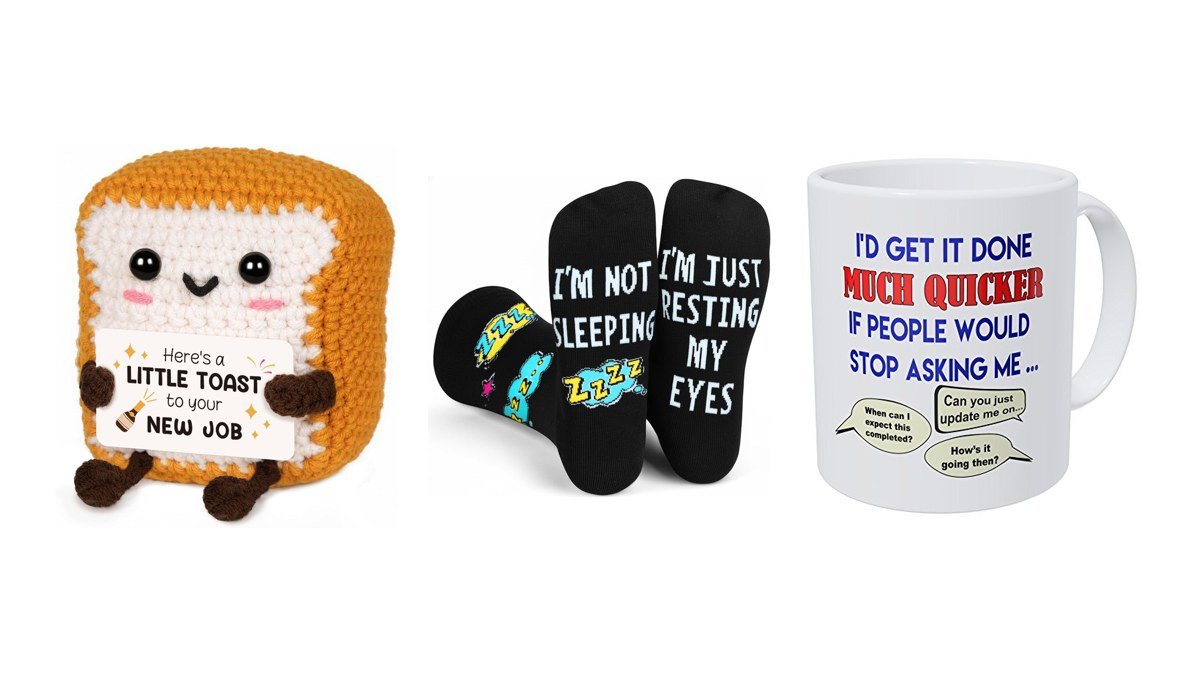
- Wearables with a soft punchline. Novelty socks and shirts are funny at exactly the right volume for a room with grandparents in it.
- Food that is a dare. Extremely hot sauce or aggressively flavoured snacks turn a gag into a group activity, which defuses everything.
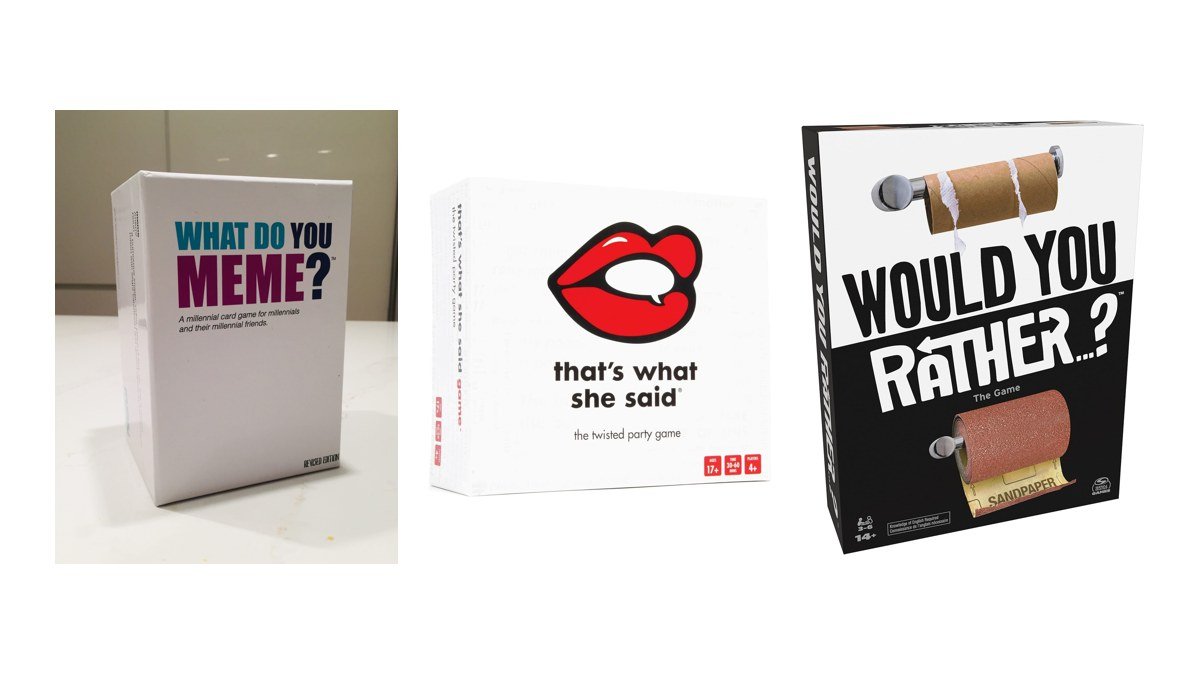
- A game. If your instinct is chaos, redirect it into something the whole room can play. Chaos with rules is called entertainment.
The rule of the second laugh
Here is the test that experienced gift-givers use without naming it. Every gag gift gets a first laugh, because unwrapping something unexpected is inherently funny. The first laugh means nothing. It is a reflex.
Watch for the second laugh, twenty seconds later, when the recipient has understood the joke fully and looks up. If the second laugh comes from the recipient, you succeeded. If the room laughs and the recipient smiles with their mouth only, the gift was about them and they are being a good sport.
You cannot observe this in advance, but you can predict it. Picture the recipient’s face at second twenty. You already know. You have known since you found the thing online.
What to actually do this weekend
Bring two gifts. Not as a hedge for the recipient, as a hedge for the room.
The first is your safe, funny, universally legible object: something absurd, well-made, and about a thing rather than a person. Ideally it costs less than you would guess, which is the entire premise of funny gifts under 25 that do not look cheap. That one gets opened in front of everyone.
The second is the one that failed the screen. Keep it in the car. If the party thins out, the kids go to bed, and you find yourself with four adults and the remains of a cheese board, bring it in then. Same gift, different room, completely different outcome.
That is the real answer to whether your gag gift is too offensive. Very few gifts are too offensive in the abstract. Most are just badly timed, badly aimed, or opened in front of a nine-year-old with excellent recall. Fix the room and you usually do not have to fix the gift.