You have decided that someone in your life deserves a large inflatable something delivered to their front door with no explanation attached, and now you are wondering how to send a prank gift anonymously without accidentally creating a situation. This is a reasonable place to end up. Anonymous prank gifting looks simple from the outside: buy the thing, ship the thing, watch from a safe distance. In practice there are return address labels, shipping systems designed specifically to prevent anonymity, workplace mail policies, and a surprisingly firm line between “funny” and “a conversation with HR.” What follows is the practical version.
Decide whether you actually want to be anonymous, or just delayed
Most people who say they want anonymity actually want a reveal. They want forty-eight hours of confusion followed by the moment the recipient works it out and texts them in all caps. That is a different project than true anonymity, and it is much easier to pull off.
Ask yourself which of these you want:
- Temporary mystery. The recipient figures it out eventually, ideally by your own design. Low risk, high payoff, and nobody spends a week feeling watched.
- Permanent anonymity. They never know. This is harder, and it is also where things go wrong, because an unexplained package from an unknown sender is not inherently funny to everyone. Some people find it unsettling.
- Group anonymity. They know it was someone in the group chat but not which one. This is the sweet spot for most pranks and requires almost no logistics beyond conspiracy.
If you are honest with yourself and land on temporary mystery, you have just eliminated about eighty percent of the difficulty. You can use your real name, ship normally, and simply say nothing for two days. The rest of this guide is for the people who want more.
The return address problem nobody warns you about
Here is the thing that trips up first-time anonymous gifters: shipping systems are built to send things back. Carriers want a return address because packages fail. They get refused, they get damaged, addresses turn out to be wrong, and when that happens the parcel needs somewhere to go. If you leave the return address blank or fake, you have created an undeliverable package that ends up in a facility for unclaimed mail rather than on your target’s doorstep.
Your realistic options:
- Use your real return address and accept the risk. Most people never look at the return label closely, especially on a printed shipping label from an online retailer. This is boring advice and it works most of the time.
- Ship directly from the retailer. The return address becomes a warehouse in a state neither of you has visited. The gift message field is where you control the narrative, and you can leave it cryptic or blank.
- Recruit an accomplice in another city. Their address goes on the label, they know nothing, and the postmark misdirects beautifully. Ask permission. Do not volunteer someone’s address without telling them.
The retailer route is the cleanest, which is why most successful anonymous pranks are ordered online rather than boxed up at home. It also means the item arrives in packaging that looks legitimate, which matters more than you think for the initial reaction.
What the gift message field can and cannot do for you
Nearly every online store offers a gift message. This is your entire creative budget for anonymity, so use it well. A blank message reads as an error. A vaguely threatening message reads as a threat. The goal is something that is clearly a joke while giving away nothing.
Options that work:
- “You know why.”
- “Congratulations on the thing.”
- “This was the least I could do. Literally.”
- “Per our earlier conversation.”
Options that do not work: anything referencing where they live, anything implying you are watching them, anything that could be read as a warning. Tone is nearly impossible to convey in twelve words on a card, and confusion plus no context tilts negative fast. Keep it obviously silly. A message that sounds like a bad sitcom is safer than one that sounds clever.
Choosing an item that survives being mysterious
Some prank gifts are funny regardless of who sent them. Others only work with context, and those are the ones that land badly when the sender is unknown. Your item needs to be self-explanatory as a joke.
Good anonymous prank categories:
- Absurd but harmless objects. Anything from the world of weird home decor that nobody needs but everyone wants works here, because the humour is entirely in the object itself.
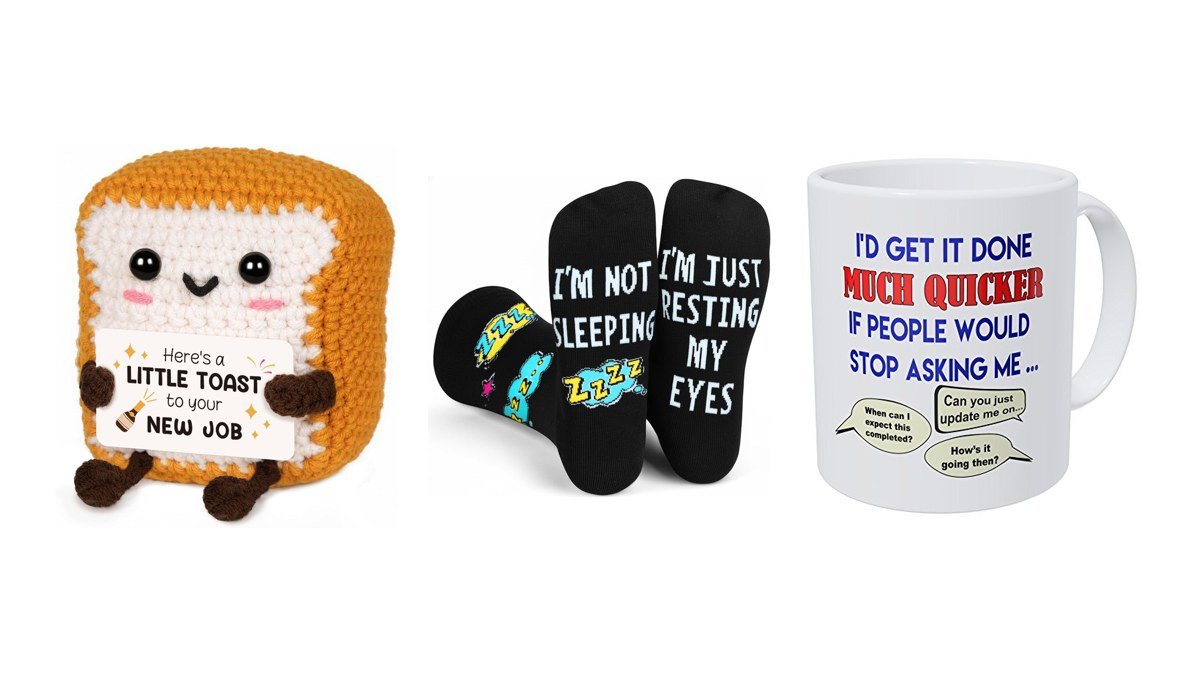
- Novelty clothing. Socks and boxers with unhinged printing are visibly a gift, visibly a joke, and cheap enough that the recipient does not feel indebted. The better options in the funny novelty clothing category are wearable, which extends the joke past the unboxing.
- Deliberately terrible food. Handle with care. Anonymous food is a genuine trust issue, so stick to sealed, branded, obviously commercial products. Some of the entries in the weird food gift roundup are unopened cans of regret, which is exactly the right energy.
- Novelty tech. Useless gadgets read as a joke immediately and rarely offend anyone.
Avoid anything that could be mistaken for sincere criticism. A book about improving one’s personality, sent anonymously, is not a prank. It is an insult with shipping costs.
The workplace rules you should treat as non-negotiable
Sending a prank gift to someone’s office multiplies the audience. The recipient is no longer just your friend; they are your friend surrounded by colleagues, a mailroom, and possibly a manager who has to decide whether this constitutes an incident.
Lines worth respecting:
- Nothing that references bodies, appearances or private habits. The entire genre covered in the toilet humour gift guide is genuinely funny among friends and genuinely a problem when opened at a shared desk.
- Nothing anatomical, nothing suggestive. Even mildly. Even ironically. The person receiving it does not get to control who sees it.
- Nothing that requires assembly, makes noise, or smells. Colleagues did not consent to your bit.
- Nothing sent to a workplace where the recipient is new or junior. They are still building a reputation. Do not hand them a weird one.
If the joke only works at their office, the joke is probably not worth it. Send it home. Home is where prank gifts belong.
Legal considerations, briefly and without drama
You are not going to get arrested for mailing someone a rubber chicken. But there are a few genuine boundaries. Anything that could be interpreted as a threat, anything containing a substance the recipient cannot identify, anything designed to alarm rather than amuse – these stop being pranks and start being harassment, particularly when repeated. Frequency matters. One unexplained parcel is a mystery. Five is a pattern, and patterns are how ordinary annoyances become legal ones.
Also worth knowing: many carriers have restrictions on what can be shipped, and hiding a prohibited item inside a joke gift is a real problem with real consequences. If you find yourself wondering whether something is allowed in the mail, that instinct is correct and the answer is usually no.
And do not send anonymous gifts to someone who has asked you to stop contacting them. Obvious, but it needs saying.
How to build a group prank that shares the blame
The most reliable anonymous prank format is the conspiracy. Three or four people chip in, one person places the order, and nobody confirms who did what. The recipient has suspects but no evidence, which is far more entertaining than pure mystery, and the whole thing reads as affection rather than surveillance.
This structure also lets you escalate safely. Everyone sends something small on the same day. A parade of nonsense arriving over a week. One large item followed by increasingly small versions of the same item. This is essentially the mechanic behind a good weird white elephant exchange, just distributed across the postal system and stretched over time.
Budget honestly. Prank gifts that cost real money create obligation, which kills the comedy. The funny gifts under 25 that do not look cheap hit the right band: substantial enough to be baffling, cheap enough that nobody feels they owe you a thank-you note.
What to actually do
Order from an online retailer so the return address is a warehouse. Put something short and obviously silly in the gift message. Send it to their home, not their office. Pick an item that is funny on its own without needing context, keep it under the price point where gratitude kicks in, and send exactly one. Then wait, and reveal yourself within about a week, because the reveal is the actual punchline and holding out longer just makes it strange.
If any of that feels like too much administration, the honest answer is that you should probably just sign your name. Attach the prank to a birthday, hand it over in person, and enjoy the reaction directly – the funny birthday gift approach gets you ninety percent of the comedy with none of the shipping logistics. Anonymity is a nice garnish. It has never once been the reason a prank gift was funny.